

 RSS Feeds:
News |
- Mineral Exploration in North Causing Concern
- Climate Change Relevant to Mackenzie Valley
- Cod Stocks Decline Due to Climate Change
- Big Oil Profits, Bigger Climate Costs
- Kyoto Protocol Celebrates One-Year Anniversary
- Statistics Canada Studies Canada's Watersheds
- First Nation Sues CN Over Spill
- US Evangelicals Focus on Climate Change
- Conservation Deal to Protect Great Bear Forest
- Premier Deluged by Support for Protected Lands
- Water Project Provokes Response
- UK Parties Want Climate Change Action
| Mineral Exploration in North Causing Concern | 22 February 06 |
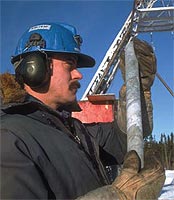 According to recent technical work undertaken by WWF Canada, the pace of the mineral rush in Canada's north is resulting in significant barriers to the establishment of protected lands and waters, and/or for protected lands as outcomes of current lands planning exercises. According to recent technical work undertaken by WWF Canada, the pace of the mineral rush in Canada's north is resulting in significant barriers to the establishment of protected lands and waters, and/or for protected lands as outcomes of current lands planning exercises.The mapping, produced by WWF Canada, but based on government data, quite dramatically illustrates the significant proportion of Canada's northern land base that is under prospecting permits, mineral leases and claims. The maps show a conservative portrayal of the situation, as oil and gas leases are not included - though such leases are extensive throughout the western Arctic. Although these permits are temporary - only a small proportion of the areas explored will actually be developed and in permanent disposition or actually mined - they severely limit options for conservation and protected areas planning. The mapping makes a case for resources to focus on protected areas planning to match the effort and resources that have been allocated to programs that promote or support the mining industry. The WWF mapping also makes a case for meaningful consultations with northern communities to identify areas of importance that are community priorities for protection. View the February 2006 WWF Canada map of 'Prospecting Permits in Relation to Existing and Proposed Protected Areas' in Canada's north Visit the WWF Canada website Source: WWF Canada |
|
| Climate Change Relevant to Mackenzie Valley | 22 February 06 |
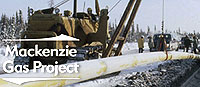 Imperial Oil's claim that climate change evidence is not relevant to the National Energy Board (NEB) review of the engineering design of the Mackenzie Gas Project is being refuted by Sierra Club of Canada. Imperial Oil's claim that climate change evidence is not relevant to the National Energy Board (NEB) review of the engineering design of the Mackenzie Gas Project is being refuted by Sierra Club of Canada."Imperial Oil is once again demonstrating its ostrich-like views on climate change," said Elizabeth May, executive director of the Sierra Club of Canada. "Instead of mounting legal challenges to the introduction of important climate change information, Imperial Oil should be focusing on ensuring that its Taglu gas anchor field can operate successfully as Arctic climate change worsens." "Significant concerns with the design of the Taglu and Shell's Niglintgak anchor fields emerged at the NEB's Inuvik hearings," said Stephen Hazell, SCC's conservation director. "Both of these anchor fields are located in the Mackenzie Delta only 1.5 m above the Beaufort Sea. Both are highly prone to spring flooding by the Mackenzie River and late summer flooding by Beaufort Sea storm surges." Neither Imperial Oil nor Shell Canada incorporated the findings of the November 2004 Arctic Climate Impact Assessment--the most comprehensive and authoritative study of Arctic climate change to date - into the design of the Taglu and Niglintgak anchor fields. "The NEB needs to ask itself whether Imperial Oil's history as a pre-eminent climate-change denier is adversely affecting the quality of the engineering design of the Taglu and Niglintgak anchor fields to respond to Arctic climate change." said Ms. May. View the full February 13, 2006 Sierra Club of Canada release View 3 Canadian Press articles by Bob Weber; February 17, February 19 & February 20, 2006 Visit the MackenzieWild.ca website Visit the National Energy Board website Source: Sierra Club of Canada |
|
| Cod Stocks Decline Due to Climate Change | 20 February 06 |
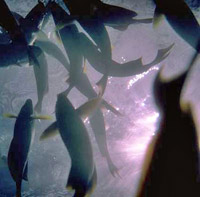 Results of a new study indicate that climate change, and not over fishing, is the principal cause of falling cod stocks in the North Sea. Results of a new study indicate that climate change, and not over fishing, is the principal cause of falling cod stocks in the North Sea.According to the Natural Environment Research Council study, changes in the North Atlantic current have disrupted supplies of plankton, which are essential for the survival of newly hatched cod. Global warming causes these changes and as a result, the amount of vital plankton in the North Sea has plummeted by 50%. It is believed that the changes in the North Atlantic current will have far-reaching implications for the environment; the cold, salty water that used to drive the Atlantic current is no longer doing so. This has a major impact on global climate because the oceans distribute energy over the surface of the globe. The study's findings follow recent research by the UK National Oceanography Centre, which found that the Gulf Stream - which carries warm water to Europe from the tropics - has weakened dramatically in recent years. View the January 1, 2006 Times Online (UK) article Source: Times Online (UK) |
|
| Big Oil Profits, Bigger Climate Costs | 20 February 06 |
 The huge "profits" of oil and gas companies would quickly turn into major losses if the social costs of their greenhouse gas emissions were taken into account. The UK-based New Economics Foundation (NeF) calculates that oil giant BP would be US$18 billion in the red, instead of having US$19 billion in profits, if the cost of emissions from their products was factored in. The calculation uses the British government's estimation that the environmental damage per tonne of carbon dioxide is in the range of US$35. The huge "profits" of oil and gas companies would quickly turn into major losses if the social costs of their greenhouse gas emissions were taken into account. The UK-based New Economics Foundation (NeF) calculates that oil giant BP would be US$18 billion in the red, instead of having US$19 billion in profits, if the cost of emissions from their products was factored in. The calculation uses the British government's estimation that the environmental damage per tonne of carbon dioxide is in the range of US$35. While oil companies pull in profits of historic proportions - US$58.9 billion between the top three in 2005 - the socio-environmental costs of climate change are having their own effect on history. Of the world's 12 largest corporations, six are oil companies and four are car manufacturers. The policy director for NeF and their report depicts a world dying of oil "addiction," and governments caught in the addiction. NeF says the UK government's heavy reliance on tax revenue from the oil sector creates a disincentive for government to address what he calls "climate chaos". View the February 9, 2006 Opinion article by Andrew Simms of NeF View the February 9, 2006 BBC article about the NeF study Visit the New Economics Foundation website Visit the BBC Climate Change website pages Sources: BBC, NeF, Fortune 500 |
|
| Kyoto Protocol Celebrates One-Year Anniversary | 17 February 06 |
 Sierra Club of Canada marked the Kyoto Protocol's one-year anniversary with the release of its third annual Kyoto Report card reviewing the different steps that have been taken by the Canadian government to meet Canada's targets under the protocol. Sierra Club of Canada marked the Kyoto Protocol's one-year anniversary with the release of its third annual Kyoto Report card reviewing the different steps that have been taken by the Canadian government to meet Canada's targets under the protocol."Three years after Canada ratified Kyoto, the protocol is alive and well. The world is on track to meeting its targets and is moving ahead with negotiations for the next commitment period," said Elizabeth May, Executive Director of Sierra Club of Canada. "In our recent national election two thirds of Canadians voted for parties that support the Kyoto Protocol," said John Bennett of Sierra Club of Canada. "Canada should continue to move forward." Since Canada ratified the Kyoto protocol, Sierra Club of Canada has issued a yearly report card monitoring Canada's progress in meeting its greenhouse gas reduction targets. This year the report is released on the one-year anniversary of the date the protocol came into force, February 16, 2005. View the Sierra Club of Canada 2006 Kyoto Report card (PDF) View the full February 16, 2006 Sierra Club release Source: Sierra Club of Canada |
|
| Statistics Canada Studies Canada's Watersheds | 16 February 06 |
 The most recent issue of the Statistics Canada newsletter, Rural and Small Town Canada Analysis Bulletin profiles the rural versus urban demographic structure of watersheds across Canada. The most recent issue of the Statistics Canada newsletter, Rural and Small Town Canada Analysis Bulletin profiles the rural versus urban demographic structure of watersheds across Canada.In the publication, watersheds are grouped according to the proportion of their populations that is defined as rural (according to the Statistics Canada census data). The intention is to provide baseline data for further analysis and to help inform the policy dialogue regarding the protection and use of fresh water in Canada. Useful information such as watersheds inhabited solely by rural residents, watersheds characterized by a majority of rural residents, watersheds inhabited by a vast majority of people living in larger urban centres is presented graphically, through discussion in the text, and in statistical charts. The information presented sends a clear message to both rural and urban stakeholders that participation in land and water issues within Canada's watersheds should be a priority for everyone if sustainability of water resources is to be achieved. View the January 2006 Statistics Canada newsletter Rural and Small Town Canada Analysis Bulletin, Volume 6, No. 6 (PDF) Source: Statistics Canada |
|
| First Nation Sues CN Over Spill | 16 February 06 |
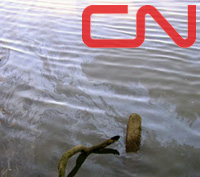 The Paul First Nation in Alberta, Canada, is suing CN Rail for $505 million in damages resulting from a train derailment that dumped diesel fuel and oil into a lake in their traditional territory. The massive spill contaminated Lake Wabamun 70 kilometers west of Edmonton in August 2005. The Paul First Nation in Alberta, Canada, is suing CN Rail for $505 million in damages resulting from a train derailment that dumped diesel fuel and oil into a lake in their traditional territory. The massive spill contaminated Lake Wabamun 70 kilometers west of Edmonton in August 2005. The suit also seeks $200 million from the Canadian government for failing to fulfill its legal obligations to the First Nation, and $70 million from the Alberta government for issuing an environmental protection order without consultation. The waters and shores of Lake Wabamun are vital to the 1,700 members of the Paul First Nation as a source of fish, geese, ducks, berries, medicinal plants and spiritual well being. "There's tar balls everywhere," says Chief Daniel Paul of the irreparably damaged lake. "There's still evidence of contamination everywhere... That water was clear for centuries and now we're dealing with a disaster." CN is coming off a year of record financial performance, with 2005 revenue of $7.2 billion and profits of $1.6 billion. View the February 7, 2006 CBC article View the February 7, 2006 CTV article View the February 8, 2006 Edmonton Journal article View the 2005 CN Financial Release Sources: CBC, CTV, CN |
|
| US Evangelicals Focus on Climate Change | 16 February 06 |
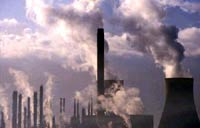 Hoping to urge church-goers and law-makers to get to work on climate change, prominent Christian leaders in the US have launched the "Evangelical Climate Initiative" with a statement signed by 86 college presidents, mega-church pastors and aid organization representatives. Hoping to urge church-goers and law-makers to get to work on climate change, prominent Christian leaders in the US have launched the "Evangelical Climate Initiative" with a statement signed by 86 college presidents, mega-church pastors and aid organization representatives.They want legislation that would utilize market mechanisms to reduce emissions. Their statement also stresses the need for renewable energy and hybrid vehicles. The group is placing TV and print ads, including a full-page in the New York Times. A different set of leaders - including rightwing heavy-weights James Dobson and former Nixon aide Charles Colson - had urged the group not to speak up on climate change, citing inconclusive science. View the Statement of the Evangelical Climate Initiative View the February 8, 2006 CNN article View the February 10, 2006 Seattle Post-Intelligencer article View the January 2006 letter signed by Dobson and Colson View the February 8, 2006 New York Times article View the February 14, 2006 Christian Science Monitor article Sources: Evangelical Climate Initiative, Interfaith Stewardship Alliance |
|
| Conservation Deal to Protect Great Bear Forest | 13 February 06 |
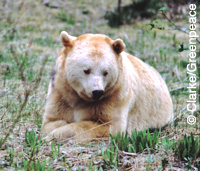 A coalition of three environmental groups - Sierra Club of Canada, BC Chapter, Greenpeace, and ForestEthics - along with industry leaders and indigenous groups, celebrated success after a decade long campaign to protect the globally unique Great Bear Rainforest. The long awaited government announcement February 7, 2006 will protect one third of the Great Bear Rainforest from all logging and will require the use of more sustainable logging practices for the remaining area. A coalition of three environmental groups - Sierra Club of Canada, BC Chapter, Greenpeace, and ForestEthics - along with industry leaders and indigenous groups, celebrated success after a decade long campaign to protect the globally unique Great Bear Rainforest. The long awaited government announcement February 7, 2006 will protect one third of the Great Bear Rainforest from all logging and will require the use of more sustainable logging practices for the remaining area."Today, British Columbians are showing that it is possible to protect the environment and provide the economic foundation for healthy communities," said Lisa Matthaus, Coast Campaign Coordinator for the Sierra Club of Canada, BC Chapter. "This innovative rainforest agreement provides a real world example of how people and wilderness can prosper together." Much of the area being protected from logging will also be protected from other forms of development, but some e areas only exclude logging. Some environmental groups have noted that independent scientists recommended more protection for the Great Bear Rainforest and the GBR agreement should not be a reason to stop pressing for more protected lands. View the February 7, 2006 release from: Sierra Club of Canada, BC Chapter, Greenpeace, and ForestEthics (PDF) View the backgrounder on the Great Bear Rainforest (PDF) View the February 7, 2006 New York Times article View the February 4, 2006 Vancouver Sun article View the February 7, 2006 Washington Post article on the ForestEthics site Visit the Great Bear Rainforest web site View a Map of the Great Bear Rainforest in British Columbia View the February 7, 2006 British Columbia Government release Sources: Sierra Club of Canada, BC Chapter, Greenpeace, and ForestEthics |
|
| Premier Deluged by Support for Protected Lands | 10 February 06 |
 The latest Natural Resources Defense Council (NRDC) appeal to its supporters to take action in support of the Heart of the Boreal BioGem has triggered a huge response! Over 82,000 letters urging Manitoba Premier Doer to protect First Nations lands in the boreal have been sent to date. The latest Natural Resources Defense Council (NRDC) appeal to its supporters to take action in support of the Heart of the Boreal BioGem has triggered a huge response! Over 82,000 letters urging Manitoba Premier Doer to protect First Nations lands in the boreal have been sent to date.Pauingassi and Little Grand Rapids First Nations, whose traditional territories are located in the Heart of the Boreal on Manitoba's east side, have requested interim protection for their lands. The communities' need to have protection in place while they move forward with community planning initiatives for protected lands, and potential World Heritage status, as part of a larger WHS nomination. The previous NRDC Take Action in support of protection for these traditional lands generated 55,000 letters to Manitoba Conservation Minister Struthers. These two NRDC BioGem take actions have sent 137,000 letters to Manitoba government leaders. To date the Manitoba government has taken no action to provide security from development during community planning, and has not sent funding to the communities involved in the WHS nomination. Add your voice - visit the NRDC BioGem web site for the Heart of the Boreal to learn more and Take Action.  Take Action at the NRDC BioGem web site for the Heart of the Boreal Visit Manitoba Wildlands' updated Take Action centre Source: Natural Resources Defense Council |
|
| Water Project Provokes Response | 09 February 06 |
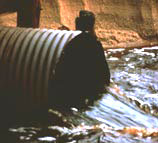 Manitobans have responded to a proposed project in the Sandilands Provincial Forest that would move groundwater approximately 96km through a pipeline to a treatment plant in Morris, MB and then to customers in south-central Manitoba. Manitobans have responded to a proposed project in the Sandilands Provincial Forest that would move groundwater approximately 96km through a pipeline to a treatment plant in Morris, MB and then to customers in south-central Manitoba.The project, proposed by the Pembina Valley Water Cooperative (PVWC), is of concern for several reasons. Groups have commented on the lack of detailed information in the materials filed for public review and asserted deficiency in public notice and the public involvement process. Serious concerns have also been raised because the proposed PVWC project would constitute a sub-basin transfer of water, which is prohibited under Manitoba water legislation. Staged licensing with assumptions that future linked projects would receive automatic licenses, as contained in the proposal, are contrary to Manitoba public policy. Manitoba Wildlands is one of the groups that filed comments on the PVWC project (Public Registry File #5156.00) under the public review period that closed February 6, 2006. View Manitoba Wildlands' February 6, 2006 comments on the PVWC (PDF) Visit Manitoba Eco-Network Public Registry for the PVWC proposal (PR File #5156.00) View the February 6, 2006 Winnipeg Free Press article (DOC) View Hugh Arklie's January 26, 2006 comments on the PVWC (DOC) View January 26, 2006 Buffalo Point First Nation letter on the PVWC (DOC) View the January 25, 2006 Save Our Seine letter on the PVWC (DOC) View January 24, 2006 Glen Koroluk review comments for Friends of the Pocock Lake Ecological Reserve (DOC) Sources: Manitoba Public Registry, Manitoba Wildlands |
|
| UK Parties Want Climate Change Action | 08 February 06 |
 The five largest opposition parties in the UK Parliament are calling for an independent body with a long term mandate to set binding emission targets, advance measures to achieve year on year emission cuts, monitor emissions and report annually. The five largest opposition parties in the UK Parliament are calling for an independent body with a long term mandate to set binding emission targets, advance measures to achieve year on year emission cuts, monitor emissions and report annually.As Canadian Conservatives prepare to back away from Kyoto, UK's Conservative Shadow Environment Secretary Peter Ainsworth says "The threat of climate change is real and potentially disastrous; and current policies to tackle it are not working. To get effective action we need to suspend normal politics, find agreement wherever possible, and commit to robust long-term policies which can survive electoral cycles." The ruling Labour Party has so far declined to join in the multi-party initiative. The UK government intends to cut emissions 60 percent by 2050. Recently released government statistics reveal that UK CO2 emissions are again rising. View the January 26, 2006 Conservative Party release (DOC) View the January 18, 2006 Telegraph article Source: UK Conservative Party |
|
