


International Forest Initiatives
International Year of Forests 2011 The United Nations passed a resolution declaring 2011 the International Year of Forests. The Year will be a global event, including a large number of activities at national and regional levels. The United Nations passed a resolution declaring 2011 the International Year of Forests. The Year will be a global event, including a large number of activities at national and regional levels.The International Year of Forests 2011 offers an opportunity to raise public awareness of the challenges facing many of the world's forests and communities who depend on them. The Year will also provide a means to build momentum towards greater public participation in forest activities around the world. Official launch of the Year will take place at United Nations Headquarters during the ninth session of the United Nations Forum on Forests (February 2nd and 3rd 2011). The program will include panel discussions, media activities, film screenings, issuing the UN commemorative stamp series, and other public events. The International Year of Forests 2011 website being developed by the UNFF Secretariat will provide an online platform for all information materials for celebration of the Year. This multi-media site will feature interactive web tools to elicit feedback and dialogue, and include key components such as a calendar of national, regional and international initiatives related to the Year, which will feature forest news items and a press kit with fact sheets, brochures and other informational documents related to critical forest issues. View United Nations International Year of Forests 2011 websiteView Resolution adopting 2011 as International Year of Forests Visit United Nations Forum on Forests Source: United Nations
NASA's Earth Observatory NASA's Earth Observatory is a part of the Earth Sciences Division of NASA - the (US) National Aeronautics and Space Administration. The Earth Observatory provides freely-accessible new satellite imagery and scientific information about our home planet. The focus is on Earth's climate and environmental change, but a great deal of information about the Boreal forest can be found here.
View the Earth Observatory Feature: The Migrating Boreal Forest View the Earth Observatory Feature: Evolving in the Presence of Fire View the Earth Observatory Feature: Forest on the Threshold View effects of climate change on the photosynthetic activity in Canada's forests Source: NASA's Earth Observatory
Global Forest Watch Canada GWF Canada is part of the Global Forest Watch network, an independent network of organizations that monitor and map logging, mining, road-building and other forest development within major forested regions of the world. Global Forest Watch's principal role is to provide access to better information about development activities in forests and their environmental impact. It was established by the World Resources Institute in 1997.
 Mapping Forest Landscape Fragments The anthropogenic (human) modification of forest landscapes (via road building, logging, oil and gas development, etc.) is an issue of significance for sustainable forest management. Knowing the locations, concentrations and rates of recently disturbed forest areas helps to monitor and thereby improve forest management decisions at multiple scales. The Global Forest Watch Canada report Recent Anthropogenic Changes within the Boreal Plains Ecozone of Saskatchewan and Manitoba: Interim Report and the associated maps and data present the results of the second stage of Global Forest Watch Canada's project to monitor a significant forest area in Canada. GFW Canada identified, analyzed and mapped recent anthropogenic changes within the northern Boreal Plains Ecozone of Saskatchewan and Manitoba.  Download the May 2006 backgrounder on Recent Anthropogenic Changes within the Boreal Plains Ecozone of Saskatchewan and Manitoba: Interim Report (PDF) Download the May 2006 backgrounder on Recent Anthropogenic Changes within the Boreal Plains Ecozone of Saskatchewan and Manitoba: Interim Report (PDF)View the full May 2006 report, maps, figures and photos View the digital data/GIS layers for the report Forest Landscape Change Analysis 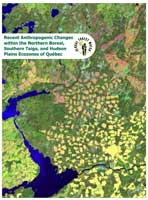 Recent Anthropogenic Changes within the Boreal Plains Ecozone of Saskatchewan and Manitoba: Interim Report is part of Global Forest Watch Canada's nation-wide project, Recent Anthropogenic Changes in Canada's Forests (working title). The project involves identification, analysis and mapping of all combined anthropogenic changes for the approximate period of 1990 to 2002 in strategically-selected areas within all eleven of Canada's forest ecozones.
 On February 9, 2006, Global Forest Watch Canada released its initial results of the forest landscape change analysis project: Recent Anthropogenic Changes within the Northern Boreal, Southern Taiga and Hudson Plains Ecozones of Québec compares satellite images from ~1990 and ~2000 to see where forest landscape disturbances occurred over this period in Québec. Download the February 2006 GFW Canada press release (PDF)Download the February 2006 backgrounder on Recent Anthropogenic Changes within the Northern Boreal, Southern Taiga and Hudson Plains Ecozones of Québec (PDF)View the full February 2006 report, maps, figures and photos View the digital data/GIS layers for the report Source: Global Forest Watch Canada
|
 2002-2014