

Search our Site:
 
  Advanced

 Sign up for
 Notices here

Donations
 
Manitoba Wildlands logo


Manitoba Forests
Manitoba Policies & Regulations
The Boreal Forest
Manitoba Forest Companies & Tenure
Canada Forest Policies
International Forest Policies
International Forest Initiatives
Canada's International Commitments

Manitoba Forest Companies & Tenure

Manitoba Forest Tenure System

Manitoba's current forest tenure system is based on the following components:
  • Provision of long-term forest management license agreements (FMLAs) to forestry companies for large tracts of forest lands (FMLs). These agreements include guarantees for fibre access, or annual allowable cut for the company within the license area. The company must fulfill the license agreement, file forest management plans, and acquire environmental licenses for its mills and woodland operations.
  • Provision of annual 'quota' timber harvesting rights to individual entities (individuals and/or companies) within specified tracts of lands. The province manages the forests where quota holders operate outside FML boundaries. The company manages the forest, and the quota holder arrangements inside FML boundaries.
Forest Management License Areas Manitoba
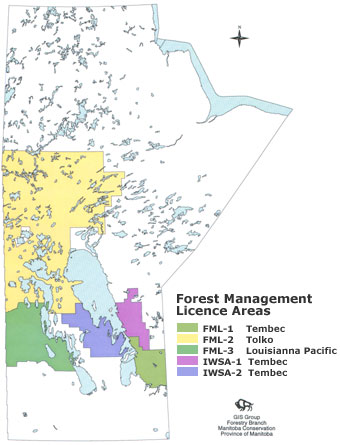
FMLA MB map
Larger Image
In addition to these two main tenure forms, Manitoba has provisions for short-term timber allocations:
  • Provision of special allocations (fixed term - agreements with First Nations)
  • Provision of timber sales (single year sales without competition)
  • Provision of timber auctions (single year)
  • Provision of timber permits (less than 300 cubic meters where the permittee intends to sell; less than 100 cubic meters where the permittee intends for personal use - one year max)
There are also private woodlots that are not managed by the province. These may be part of a forest management plan, especially where Louisiana Pacific operates in Manitoba.

For information regarding Manitoba's tenure system, forest management license areas & agreements, wood permits and quotas, see the Manitoba Conservation Forestry Branch web site.

Manitoba Forest Companies


Louisiana-Pacific Canada Ltd.
LP logoLouisiana-Pacific (LP) currently holds FML 03. Its environmental licence for its ten-year (1996-2005) forest management plan (FMP) expired December 31, 2005 (Licence No 2191E) and was extended by two years from January 1, 2006 to January 1, 2008. Louisiana-Pacific has also submitted an annual operating plan (AOP) that details its proposed harvesting and renewal activities for the upcoming year. See Public Registry File No. 3893 for details.

LP's license area in Manitoba is the newest, farthest south forest management area in Canada. The upcoming licensing and planning process is the first renewal for the company.

LP established a website - the Swan Valley Forest Management Plan Website - in preparation for the submission of a new long-term forest management plan (FMP).

As outlined in LP's forest management agreement with the Province of Manitoba, LP is required to develop and submit for approval another long-term forest management plan before the current 10 Year Plan expires. The next long-term plan will provide an 'update' on LP's activities under the current plan and provide strategic direction for forest management activities into the future. This 'update' will incorporate new data from surveys and inventories that have been completed over the last 9 years. It will also integrate new knowledge and understanding of the Duck Mountain forest ecosystems we have learned from our many research and monitoring projects, as well as relevant studies from across Canada.

Louisiana-Pacific's twenty-year forest management plan (FMP) is now available on its website and is dated June 2006.

View Louisiana-Pacific's Sustainable Forest Management Plan (2006-2026)

Although it is now public, LP has not formally submitted its 20-year plan to Manitoba Conservation or submitted a proposal under The Environment Act.

As of January 2007, there has been no public indication of the next steps in the public review process or confirmation of Environmental Impact Statement (EIS) guidelines, which LP is to use as the basis for its EIS and application for its new environmental license. Ministerial correspondence does confirm that the 1999 Guidelines for Ten Year Forest Management Plans are the basis for LP's new long term plan. It is expected that public hearings will be held as part of The Environment Act review of LP's Sustainable Forest Management Plan (2006-2026), but there has been no public notice as to terms of reference for a Clean Environment Commission hearing.

The only public information regarding the fate of the company's long term plan is a letter filed by the director of environmental approvals in Manitoba. The letter cites problems with response by LP to Manitoba Conservation concerns.
View the August 28, 2006 Manitoba Conservation letter to LP (JPG)

Manitoba forestry The impending review of LP's Sustainable Forest Management Plan (2006-2026) represents a unique opportunity for independent cumulative assessment of the assumptions and predictions that were the basis for approval of the 1995 Louisiana-Pacific Canada Ltd./TetrES Forest Management Plan/Environmental Impact Assessment. Independent cumulative assessments could be invaluable tools for improving the rigour of the review process for LP's long-term FMP. Manitoba Conservation recently completed an updated inventory for the Louisiana Pacific forest region in western Manitoba. This data is now available to compare with the assumptions of LPs 1995 FMP.

Dan Soprovich, former provincial biologist for the same forest region, has undertaken a comparison between forest growth assumptions in the 1995 Louisiana-Pacific Canada Ltd./TetrES Forest Management Plan (FMP)/Environmental Impact Assessment and 2004 Manitoba Conservation Forestry Branch wood supply analysis assumptions. The comparison document also examines the veracity of the Company/Consultant assumptions for the 1995- 2005 environmental license.

Mr. Soprovich's analysis indicates that in relation to the 'true' yield at age 60 (years since disturbance), the 1995 Louisiana-Pacific/TetrES assumptions were inflated by 2.07 times for the aspen forest, and by 2.53 times for the mixed deciduous forest (aspen, balsam poplar, and white birch).

downloadDownload Environmental Impact Assessment Information Note No.6: Trembling aspen and hardwood yield assumptions for Duck Mountain, Manitoba (PDF)

Tembec Industries Inc.
Tembec logoTembec has a Canadian operations website, but is also has a website specific to its Manitoba operations that was publicly launched November 28, 2006.

Tembec's Manitoba site provides information to the public on Tembec's activities in FML 01, including Forest Management Plans, Public Meetings, Forest Monitoring and Research Reports, our Environmental Management Systems, and Forest Certification.

Tembec Industries Inc acquired the operations, mill, and FMLA for Pine Falls Paper Company in stages starting in 1998. Its forest management legal agreement with Manitoba expires at the end of 2008. Tembec Industries Inc. currently holds FML 01 (License No. 1557 ER) in addition to harvesting rights in IWSA 1 & IWSA 2. The company is also a quota holder in other forest regions, and acquires fibre from five natural regions in the province. Tembec has submitted annual Operating and Renewal Plan since its long-term forest management plan expired in 1994. The company has been granted one-year license extensions to its license under the Environment Act each year.

Tembec committed to delay submission of a long-term sustainable forest management plan until the completion of Manitoba Conservation's wide-area land use planning initiative for the East Side of Lake Winnipeg. Tembec also delayed submission of its Interim Forest Stewardship Plan due to the current softwood lumber dispute between Canada and the United States. In November 2006, Tembec released the 2006-2008 Interim Forest Stewardship Plan, presenting as a guidance document to assist in providing Tembec with input on the development of the long term plan - the 2009-2028 Forest Stewardship Plan (FSP) - which will be submitted to Manitoba Conservation for review, approval and licensing in 2008.

See Public Registry File No. 4572.00 for details. Tembec has achieved ISO 14001 EMS and FSC certification status for the Manitoba woodlands operation. The Interim 2006-2008 Plan was used by Smartwood in making the FSC Certification decision for FML 01 while the 2009-2028 FSP was being developed.

Manitoba Conservation has started the sequence of steps to arrive at a new long term forest management plan and operating plan, new environmental license for Tembec in FML 1. The public review of Environmental Impact Statement Guidelines closed in March 2008. Manitoba Wildlands provided comments.

View Manitoba Conservation's information on Tembec
downloadDownload Manitoba Wildlands March 2008 Comments MWL owl (PDF)

Tolko Industries Ltd.
Tolko logoTolko Industries Ltd. currently holds FML 02 (License No. 2302 ER) and operates within the parameters of a 1997-2009 FMP and associated EIS (Public Registry File # 3094.60). It acquired the REPAP operations and mills in The Pas in 1997. The current FMP/EIS was originally filed by Repap Manitoba Inc. but was assumed by Tolko when the company took over Repap's Manitoba operations. Tolko submits an annual operating plan (AOP) for its proposed harvesting and renewal activities. The environmental license for its operations is multi year, on the same timeline as it forestry license. Tolko is currently pursuing ISO 14001 EMS and CSA certification status.

In March 2008, Tolko Industries Inc. made an application under the Environment Act for construction of an all weather road through Grass River Provincial Park (Public Registry File #3094.70). The proposed Dickstone South Road would bisect areas of boreal forest within the Park that have been closed to logging and potentially affect the Naosap Woodland Caribou herd. The Naosap herd is of high concern, according to the Manitoba's 2005 Conservation and Recovery Strategy for Boreal Woodland Caribou (PDF). It should be noted that this road is to provide access to logging areas, and that the Tolko long term forest license ends in 2009. The road would not be completed until 2010.

Manitoba Wildlands has mapped the Grass River Park, based on the management plan for the park, showing the requested road corridor. The Park maps show closed areas, caribou and moose areas, etc.

View June 2008 Manitoba Wildlands Map of Grass River Provincial Park - Proposed Road and Wildlife MWL owl
View June 2008 Manitoba Wildlands Map of Grass River Provincial Park - Proposed Road and Closed Areas MWL owl
View August 2008 Manitoba Wildlands Map of Grass River Provincial Park - Drill Holes and Mining MWL owl

Woodland Caribou are listed as a threatened species under provincial Endangered Species legislation, and Canada's Species At Risk Act, and require special consideration in the context of development decisions.

The proposal was open for public comment until May 2008. Manitoba Wildlands submitted comments, along with other concerned groups and individuals, including the Manitoba Wilderness Committee.

downloadDownload May 14, 2008 Manitoba Wildlands' comments on Tolko's proposed Dickstone South Road through Grass River Provincial Park MWL owl (PDF)
downloadDownload May 14, 2008 Manitoba Wilderness Committee comments on Tolko's proposed Dickstone South Road through Grass River Provincial Park (PDF)
Ainsworth Lumber Co.
Ainsworth logo Vancouver-based Ainsworth Lumber Co. is interested in building a $250-million oriented strand board (OSB) plant northeast of Winnipeg, to produce a plywood-like product used in home building for roofing, walls and floors. Ainsworth is the fourth largest producer of OSB in North America with plants in Minnesota, Alberta, British Columbia and Ontario.

The May 2006 announcement regarding the project was the result of a March 2005 request for proposals from the Manitoba Government. The First Nations Forestry Limited Partnership (FNLP), a consortium of Aboriginal communities located in Manitoba's Interlake and east of Lake Winnipeg, is also seeking an industry partner to develop hardwood inventory in the region.

Ainsworth was the successful respondent and talks began among the company, FNFLP and the Manitoba Government. Apparently none of the companies currently operating mills in Manitoba responded, including Louisiana Pacific - which operates an oriented strand board on the west side of the province.
The First Nations Forestry Limited Partnership consists of:
  • Berens River First Nation
  • Bloodvein First Nation
  • Brokenhead First Nation
  • Dauphin River First Nation
  • Fisher River Cree Nation
  • Lake Manitoba First Nation
  • Peguis First Nation
  • Sagkeeng First Nation
  • Jackhead (Kinonjeoshtegon) First Nation
  • Skownan First Nation (Waterhen)
  • Pinaymootang First Nation (Fairford)
  • Little Saskatchewan First Nation
  • Shoal Lake Band #40

Very little information has been made public as of March 2007 regarding the Ainsworth OSB venture. What is known about the proposed venture is that:
    lumber truck
  • although Ainsworth is committed to building the Manitoba plant, it intends to complete capital projects already underway before it starts on new plants
  • the plant will create an estimated 350 direct and 280 indirect jobs
  • Ainsworth agreed to partner with the FNFLP
  • The FNFLP members are in negotiations to own up to 25% of the OSB plant, which could entail capital investments of 25% for both equity and debt - approximately $62.5 million
  • working with First Nations was a condition of bidding on this possible mill, and fiber agreement.
  • the province has agreed to allocate 838,000 cubic metres of hardwood each year, in a renewable 20-year license (this volume equates to almost 21,000 40-foot shipping containers)
  • the fiber allocation will come from existing forests designated for logging (much of the areas in southeastern Manitoba are logged only for softwood trees, leaving hardwoods behind; OSB uses only hardwoods such as birch and poplar)
  • a mill location near Selkirk Manitoba is rumoured
  • Ainsworth will be required to obtain a forest management license and environmental license for both the mill and woodlands operation. which will also involve public hearings
  • constitutionally required consultations with First Nations will occur because much of the hardwood in question is on traditional land.
  • protected areas networks are not completed in the natural regions affected by the intended mill. Over 25 candidates for protection signed off for protected status by the mining industry and Tembec has been waiting since 2002 for protected status.
  • Manitoba's NDP government has promised in both of the last provincial elections that protected areas networks would be in place prior to any new forestry licenses.
What is not known about the Ainsworth OSB plant, agreements, etc.:
  • details regarding the geographic extent of the new forest management licence (FML), in relation to existing quotas, FML wood permits for softwood, some hardwood
  • details regarding where the hardwood would be harvested from, relative to the locations of the 13 FNFLP First Nations, or other First Nations who may not be participating
  • details regarding agreement(s) being negotiated between Ainsworth and the Government of Manitoba and between Ainsworth an the FNFLP
  • details regarding timelines for environmental review and licensing process, and for constitutional consultations with affected First Nations
downloadDownload May 11, 2006 Ainsworth Lumber Co. press release (PDF)
View May 15, 2006 transcript of the Legislative Debates on Ainsworth


Forestry Company Responsibilities


lumber Forestry companies assume broad levels of management control and responsibility through the provisions of their forest management licenses agreements, environment license, and long or short term forest management plan. Annual operating plans also must be accepted by Manitoba Conservation. Little public review of annual operating plans or access to assessment of woodlands operations is available. Manitoba Conservation's forestry administration is divided into ten separate Forest Sections with each section having a number of Forest Management Units (FMUs). Forest inventories (generally still a timber inventory) are analyzed to determine annual allowable cut (AAC) of softwood and hardwood tree species for each individual FMU. Harvesting cannot exceed the AAC limit, or caps in forest management license agreements.

Forestry companies must submit long-term Forest Management Plans (FMPs) in addition to an Environmental Impact Statement (EIS). The EIS must identify potential environmental effects and respond to EIS Guidelines. The FMP must be developed in accordance with current provincial policies and guidelines. FMPs must describe proposed harvesting, access development and forest renewal activities. FMPs must also describe the forest values, planning framework and consultation process, preferred management approach, operating practices, and a sustainable wood supply analysis.

In addition to FMPs, forestry companies are required to submit Annual Operating Plans (AOPs) that describes in detail the timber harvesting, access development, and forest renewal activities proposed for the current year. AOPs also identify proposed general activities for the following two years. Forest developments of greater than 300 cubic meters per year are considered Class 2 Developments under the Manitoba Environment Act and require the submission of an Environment Act Proposal Form to the Environmental Approvals Branch within Manitoba Conservation.

Manitoba Forestry Industry History


Manitoba's forestry industry is tied to the history of the province's settlement and dates back to the early 1870s.

This 2000 report, authored by the Historic Resources Branch of the Manitoba government, provides an overview of the forest harvesting and lumber industry history from the 1870s through to the middle of the 20th century.

downloadDownload February 2000 report, The Lumber Industry in Manitoba (PDF)


Manitoba Wildlands2002-2008